Restoration
Mold Remediation
Mold is a symptom. Removing what you can see without finding the moisture feeding it guarantees it comes back. We contain the area, remove the affected material properly, and deal with the water problem underneath it.
24/7 Emergency Response
Water coming in right now?
Mold can start on damp material within 24 to 48 hours. The sooner extraction and drying begin, the less has to be torn out and rebuilt.
Call any hour. Someone picks up.
The Problem
You smell it before you see it.
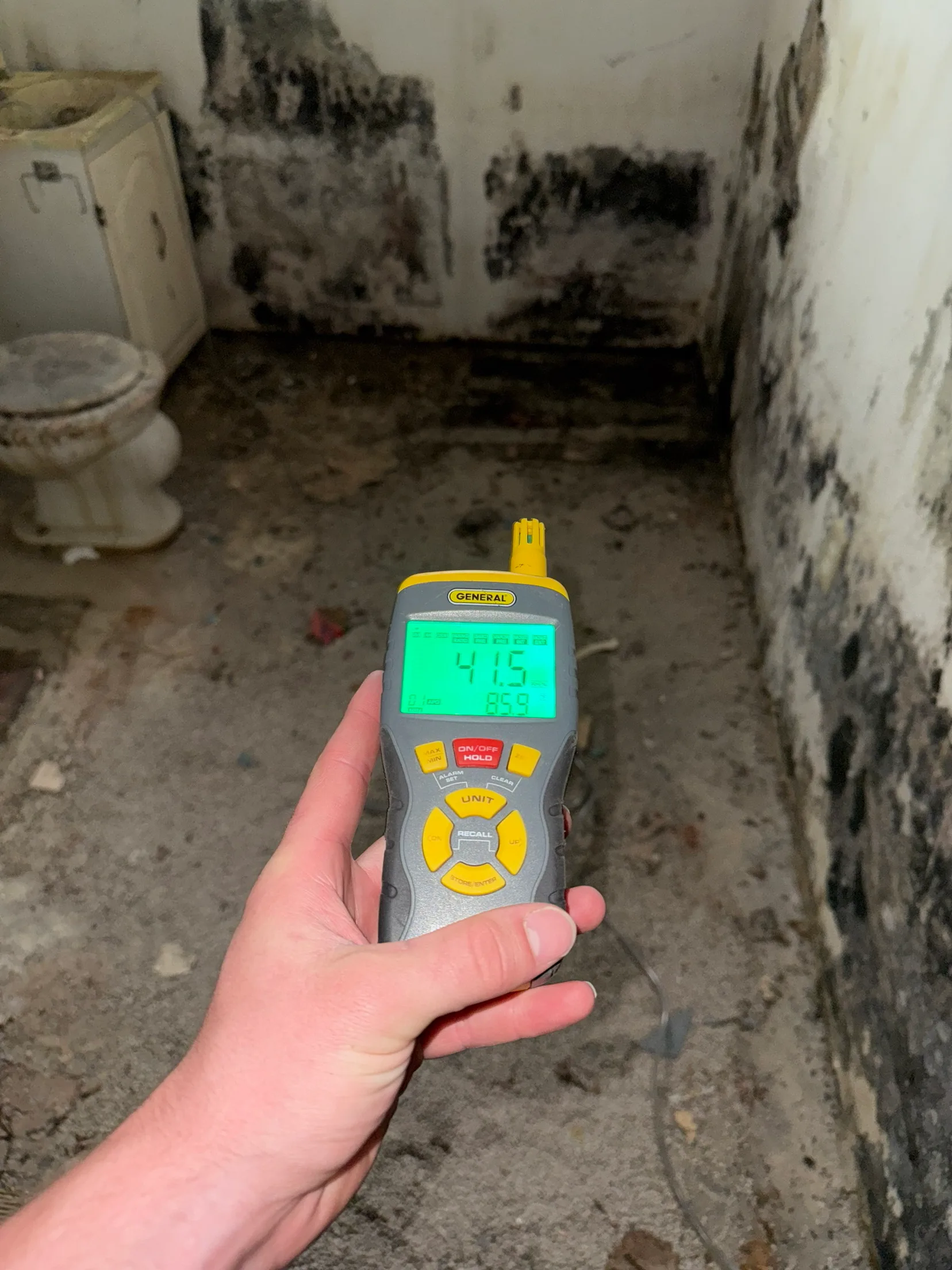
Usually you smell it before you see it: that earthy, damp note in a basement or bathroom. Then dark staining appears on drywall, on sheathing, in the crawlspace. Painting over it hides it for a few weeks.
What the job includes
- Containment barriers and negative air pressure
- HEPA filtration and HEPA vacuuming
- Removal of affected porous materials
- Antimicrobial treatment of sound surfaces
- Source moisture identified and corrected
- Full PPE, because this is not a job to do in a t-shirt
How It Goes
Step by step.
- 01
Find the moisture
Every mold problem has a water problem behind it. We locate it first, because remediation without correcting the source is temporary by definition.
- 02
Contain the work area
Plastic barriers sealed to the surrounding structure, with negative air pressure inside the containment so spores disturbed during removal cannot drift into clean parts of the building.
- 03
Remove affected materials
Porous materials that have been colonized come out: drywall, insulation, carpet. Non-porous and semi-porous surfaces such as framing and sheathing can usually be cleaned rather than replaced.
- 04
HEPA vacuum and clean
Surfaces are HEPA vacuumed and wiped down. Standard shop vacuums pass spores straight through the filter and out the exhaust, which is why they are not used for this.
- 05
Treat and dry
Sound surfaces are treated with an antimicrobial, and the area is dried so conditions no longer support regrowth.
- 06
Rebuild
Once the area is dry and clean we put it back. Drywall, texture and paint, so the room is finished rather than left open.
Questions
Mold Remediation: what people ask.
Can I just use bleach?
On a hard, non-porous surface like tile, bleach will kill surface mold. On porous material like drywall or framing it mostly adds water, because the mold has rooted below the surface where the bleach does not reach. That is why remediation removes material rather than just wiping it.
Do you test for mold?
Testing and remediation are deliberately kept separate in this industry, because a company that both tests and remediates has an obvious incentive to find a problem. Where testing is needed we will point you to an independent assessor rather than test our own work.
How do I know how bad it is?
Size is the usual threshold. Anything under about ten square feet is often a homeowner job, given the right precautions. Larger areas, anything in HVAC, and anything following sewage or flooding should be handled professionally with containment.
Will it come back?
Not if the moisture source is fixed. If the leak, the humidity or the drainage problem is still there, any remediation is on borrowed time. That is why finding the source is the first step here rather than the last.
Free Estimate
Get a price for mold remediation.
Tell us roughly what you are dealing with and we will come back with a real number, not a placeholder.
Also From Us